

- Shoot from a solid rest for every sight-in group, never offhand: you’re tuning the scope, not testing your arms.
- Get on paper at 10 yards, then zero at the distance your scope’s manual names, usually 20 yards on the top aiming point.
- Turn the dials the way you want the bolt to move, and adjust to the center of a three-bolt group, not to one bolt.
- On a speed-dial scope, fix long-range misses with the speed dial, not the elevation turret.
“Bore-sighted at the factory,” the box said. Your first bolts at 20 yards land two inches low and left. 😤
Fixing it takes one afternoon: set the speed ring, get on paper at 10 yards, zero the top aiming point at 20 from a rest, then check every lower mark at its distance. Use the bolts you’ll hunt with, and the ballistics behind the reticle start to make sense. 👇
What you need to sight in a crossbow scope
Gather everything before the first bolt. A sight-in session goes wrong when you improvise the rest or swap bolts halfway.
- A solid rest: a shooting bench, a tripod or sandbags under the forend, so the crossbow can’t move when the string goes.
- The exact bolts and field points you’ll hunt with, same weight every one, numbered with a marker.
- A target rated for your crossbow’s speed, set in front of a safe backstop.
- A rangefinder or a tape: 10, 20, 30 and 40 yards measured, not paced.
- Your scope’s manual, for its zero distance and how far one click moves the bolt.
- The scope caps’ hex key or a coin, and a pen to write down what you change.
Most bag targets are rated by speed. Morrell’s Double Duty 450 stops field points up to 450 fps; a faster crossbow needs a target rated higher, and broadheads need a foam target instead:

Morrell Double Duty 450
Morrell Double Duty 450 FPS Cube Field Point Archery Bag Target, Yellow | Portable Backyard Hunting Practice with Traditional Bullseyes, Nine-ball, Dartboard Game, and Deer Vitals
by Morrell
Affiliate link: I may earn a commission, at no cost to you.
Key features
- Cube bag target that stops field points up to 450 fps
- Faces with bullseyes, nine-ball, a dartboard and deer vitals
- Replaceable cover, so a worn face doesn’t mean a new target
- Carry handles for moving it around the yard
Specs
- Brand
- Morrell
- Model
- 131
- Size
- 450 FPS
- Color
- Yellow
- Length
- 0 Inches
- Weight
- 0.05 pounds
Before the first shot grab the scope and the rail and try to wiggle them. A loose ring or mount screw makes every adjustment you’re about to make worthless, so tighten anything that moves before you start.

// Free printable
Get the range log I actually use.
Seventeen printable pages: session log, score tracker, a 30-day drill challenge, a bow maintenance card, a first-season checklist and more. Join the monthly email and it lands right away.
Know your scope’s zero distance and click value first
Not every crossbow scope zeroes at 20 yards. The distance your reticle is built around is printed in its manual, and it decides where you finish sighting in.
Most multi-line and multi-dot scopes put the top line or dot at 20 yards, with one mark per 10 yards below it. Vortex’s Crossfire II crossbow scope, on the other hand, is designed around a 40-yard zero. TenPoint’s own video is a good example of how much the method varies by scope:
The maker walks through the the three scopes it shipped on its crossbows when the video was made. For its multi-line scopes, listen for where the final adjustment happens:
Make final adjustments on the multi-line scopes at 30 yards using the center line… the top line should be accurate at 20 yards… the bottom line should be accurate at 40 yards.
And that’s the catch with a blanket “sight in at 20” rule. Get on paper at 20, then finish at the distance your manual names, because that’s the mark the rest of the reticle is spaced from.
The click value matters just as much. It’s usually given at 100 yards, so at crossbow distances one click moves the bolt only a fraction of that:
| Click value (at 100 yd) | One click at 20 yd | Clicks to move 1″ at 20 yd | Clicks to move 1″ at 10 yd |
|---|---|---|---|
| ¼ MOA (about ¼″) | about 0.05″ | about 19 | about 38 |
| ½ MOA (about ½″) | about 0.1″ | about 10 | about 19 |
| 1″ | 0.2″ | 5 | 10 |
So a scope that needs “a couple of clicks” on a rifle needs a lot of clicks on a crossbow. Ten clicks that seem to do nothing at 10 yards are normal.
How to sight in a crossbow scope in 7 steps
These steps follow what crossbow makers and hunter education courses teach. Your scope’s manual wins wherever it says something different.
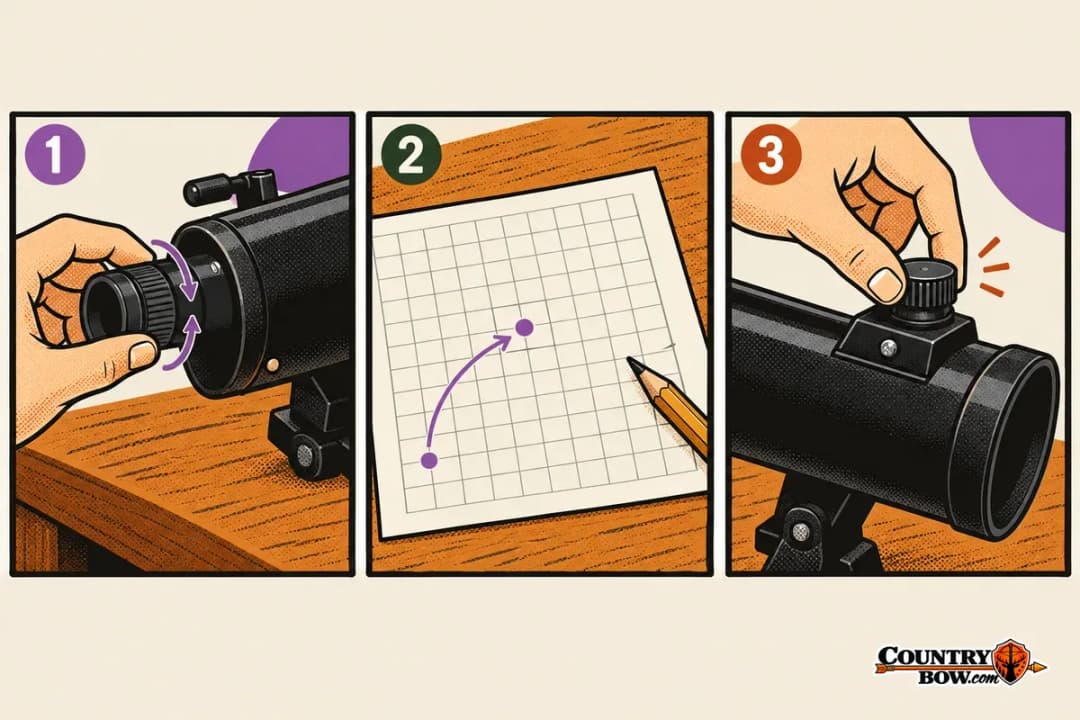
Step 1: Focus the reticle and set the speed ring
Look at a plain sky or wall and turn the eyepiece until the reticle is sharp. If your scope has a speed ring (also called a speed dial), set it to your crossbow’s real speed with your bolts, from the maker’s spec or a chronograph.
Step 2: Shoot a first group at 10 yards
From the rest, aim the top aiming point at the center of the target and shoot one bolt, then two more at the same spot. Ten yards makes sure you’re on paper before you move back.
Step 3: Move the group with the windage and elevation dials
Take the turret caps off and turn each dial in the direction you want the impact to move: bolts low, turn elevation “up”; bolts left, turn windage “right”. Adjust to the center of the group, never to a single bolt.
Hunter education courses suggest finishing this step with the group centered left to right and on the top of the bull at 10 yards, ready for the dead-center zero at 20.
Step 4: Zero the top aiming point at 20 yards
Move back to exactly 20 yards and shoot three-bolt groups on the top aiming point, adjusting after each group until it sits in the center. Three groups in a row in the same place means you’re zeroed.
Step 5: Check each lower aiming point at its distance
Shoot a group at 30 and at 40 yards on the matching line or dot. The marks below the top one are spaced by the scope maker, and a mark can hit at 28 yards rather than 30 with your bolts and draw weight.
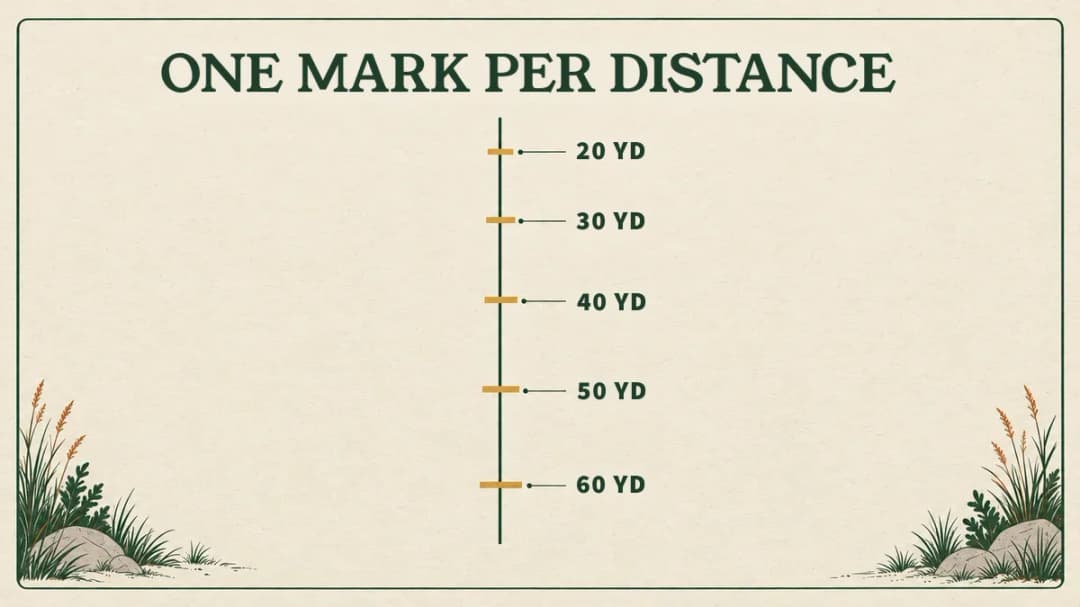
One mark per distance, with the gaps growing as the bolt drops more. Write down the real distance each mark hits; a strip of tape on the crossbow with the numbers works in the field.
Step 6: Fine-tune long range with the speed dial
On a speed-dial scope, long-range misses get fixed with the speed dial, never the elevation turret, or the 20-yard zero you just set moves too. TenPoint’s video spells out which way to turn it:
Adjust the elevation setting with the scope’s speed dial rather than the elevation dial. For example, if you’re hitting high at the 40 or 50 yard distances, adjust the speed dial to a higher speed level, or if you’re hitting low, adjust it to a lower speed level.
It sounds backwards, so it’s worth remembering in plain words: high at 40 means the scope thinks your bolts are slower than they are. Turn the dial up in small steps and shoot a group after each change.
Step 7: Confirm at 20 yards, then caps on
Walk back to 20 and shoot one more group to make sure nothing moved. Screw the turret caps back on so a branch or a case can’t turn a dial.
Which way to turn the dials: a quick chart
Crossbow scopes move the impact, not the crosshair, so you turn toward where you want the bolt to go. That’s the opposite of a pin sight, where you “follow the arrow”.
| Your group lands | Turn this dial | Toward |
|---|---|---|
| Low | Elevation (top) | Up |
| High | Elevation (top) | Down |
| Left | Windage (side) | Right |
| Right | Windage (side) | Left |
| High or low only past 30 yards (speed-dial scope) | Speed dial | Higher speed if high, lower if low |
Check the arrows printed on your own dials before the first turn. Makers don’t all turn the same way, so the printed “up” and “R” beat any rule of thumb.
Crossbow sight-in mistakes that waste bolts
Most failed sight-ins come down to a few habits. Each one makes the scope look wrong when it isn’t.
- Shooting offhand. Your wobble ends up in the zero. Rest the crossbow, and save offhand practice for after.
- Cocking by hand. A string latched a little off center pushes bolts left or right. Use the rope cocker or crank every time.
- Mixing bolts or points. A different weight hits a different spot, so the scope ends up zeroed for none of them.
- Using the elevation turret at 40 yards on a speed-dial scope, which drags the 20-yard zero with it.
- Guessing distances. Five yards of error at 40 is a miss, so measure every distance.
Coming from firearms as a former Marine, I find the scope side of this familiar: rest, group, adjust, confirm. The difference is the drop: a bolt falls far more than a bullet over the same yards, which is why every mark has to be checked at its own distance.
I shoot a recurve, not a crossbow, so this method comes from the scope makers’ manuals and hunter education, not my own bench. If your bolts still won’t group after a careful sight-in, the problem isn’t the scope: work through the crossbow accuracy fixes next.
When to re-check your crossbow scope’s zero
A zero isn’t forever. Re-check it with a quick group at 20 yards whenever something changes:
- Before every season and after any long trip in a vehicle.
- After a drop, a knock or a fall from a stand.
- After a new string or cables: a stretched or new string changes speed and impact.
- When you change bolts, points, nocks or the speed ring setting.
- Before you hunt with broadheads: sight in with field points, then confirm your broadheads (same weight) hit with them.
Shopping for a scope that holds its zero? Start with the best crossbow scopes.
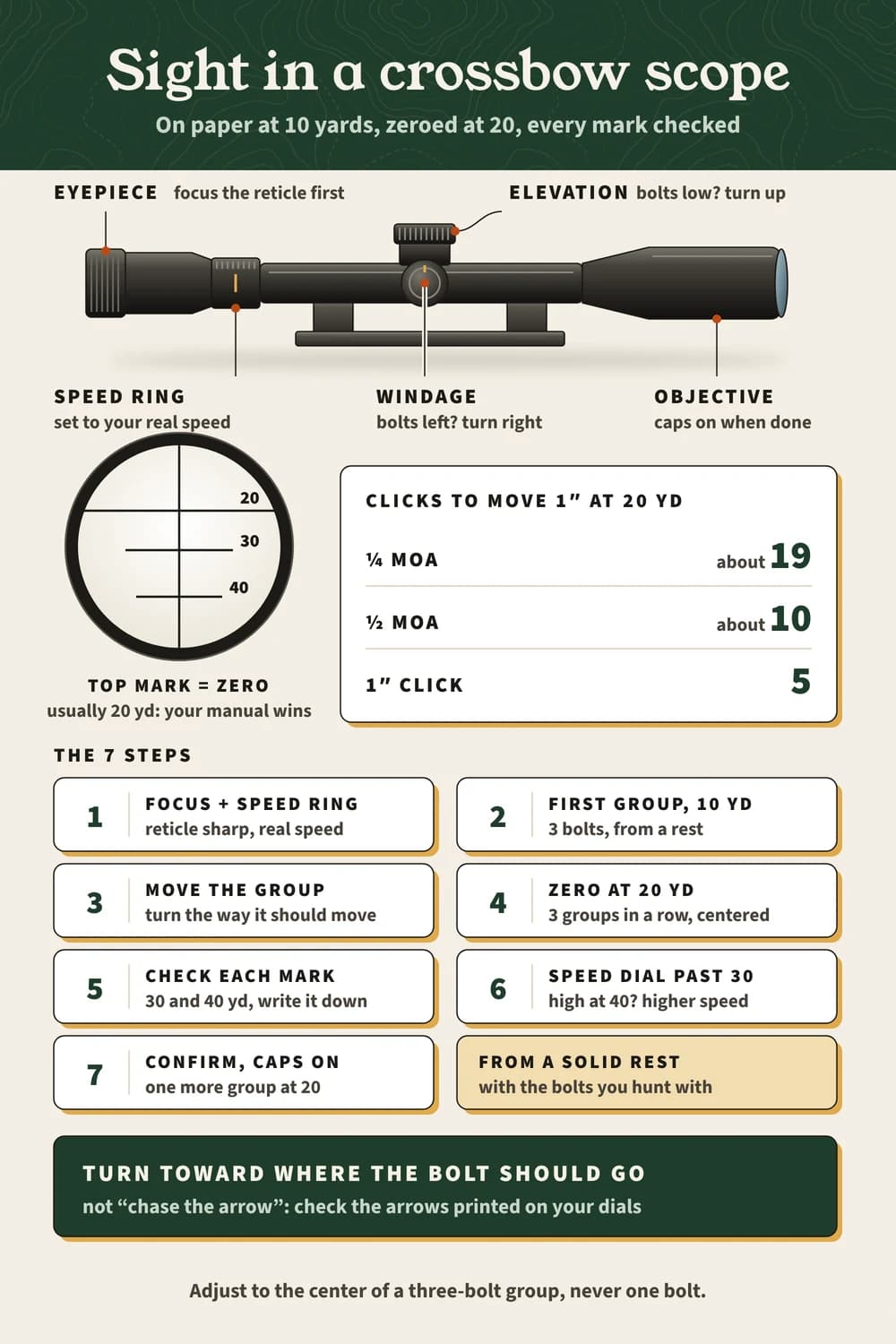
Take this one-page version of the sight-in to the range so every step and click count is in your pocket.
// FAQ
Frequently asked questions
Quick answers to the questions readers ask most.
What distance should I sight in my crossbow scope at?
Get on paper at 10 yards, then zero at the distance your scope’s manual names. For most multi-line scopes that’s 20 yards on the top line; some, like Vortex’s XBR-2 reticle, are built around 40.
How many clicks move a crossbow scope one inch at 20 yards?
About 10 clicks on a ½ MOA scope and about 19 on a ¼ MOA scope. Check your scope’s click value in its manual or on the turret.
Do you chase the arrow when sighting in a crossbow scope?
No. With a scope you turn the dials toward where you want the bolt to go; chasing the arrow is for pin sights.
Do I need to sight in a crossbow that came bore-sighted?
Yes. Factory bore-sighting gets you close, but only your bolts, your speed and your rest give a real zero, so shoot groups before you hunt.
Should I sight in a crossbow with broadheads or field points?
Sight in with field points of the same weight as your broadheads, then shoot a few broadheads into a foam target to confirm. If they don’t hit together, fix the broadhead flight, not the scope.

Final thoughts
Sighting in a crossbow scope is a short, repeatable job: speed ring, 10 yards, zero at 20, check every mark, caps on. Do it from a rest with the bolts you’ll hunt with and you’ll trust every line in that reticle.
Write down each mark’s real distance and your group sizes in the free range log, so next season’s check takes ten minutes.
