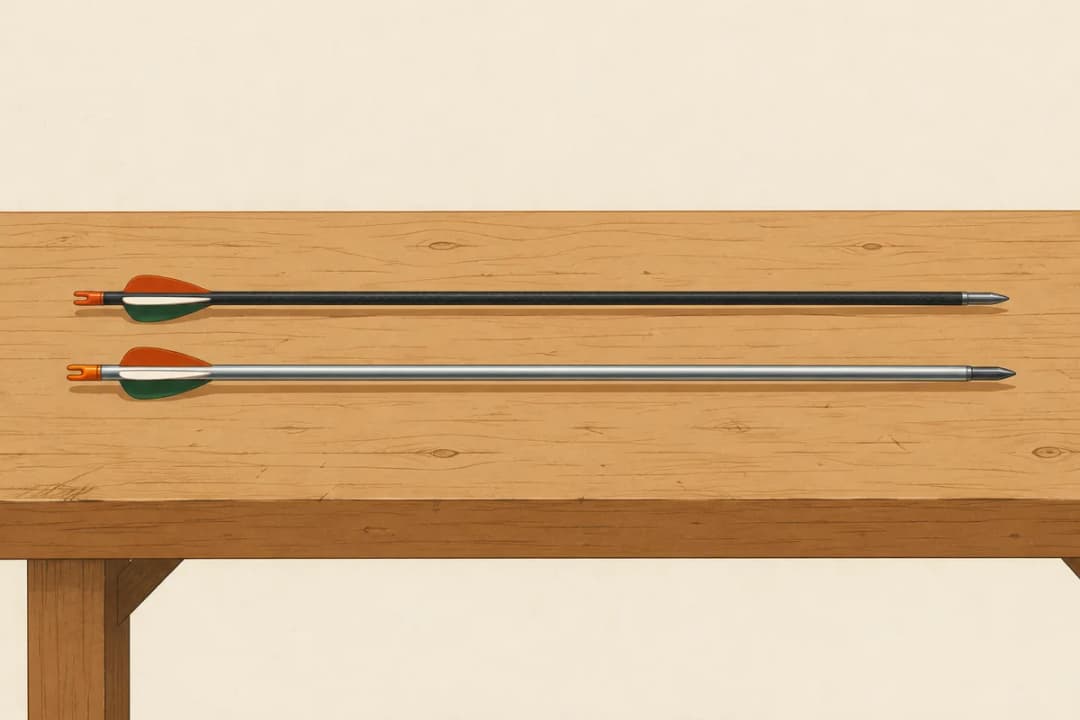


- Buy carbon for hunting and most practice: it’s lighter for its stiffness, flies flatter and stays straight.
- Aluminum gives you accuracy for less money, but a bent aluminum bolt is very hard to straighten, so it’s usually done.
- Premium carbon bolts are held to .001″ straightness; aluminum crossbow bolts are typically ±.003″.
- Flex-test every carbon bolt: carbon doesn’t bend, it cracks, and a cracked bolt can break apart at the shot.
- Whatever the material, your manual’s length, nock and minimum weight come first.
The mistake: grabbing the cheaper aluminum pack because the bolts look the same. They don’t fly the same. 😬
Buy carbon unless you only want cheap practice bolts, and match your manual’s length, nock and minimum weight either way. Below are the five differences that decide it; for specific bolts, see the best crossbow bolts roundup.
Carbon vs aluminum crossbow bolts: the short comparison
Both materials shoot accurately when they’re straight and matched to your crossbow. The real differences show up after a bad hit and over a season of practice.
| Factor | Carbon | Aluminum |
|---|---|---|
| Weight for its stiffness | Lighter | Heavier (denser alloy) |
| Trajectory | Faster and flatter | Slower and more drop |
| Straightness | Down to .001″ on premium bolts | Typically ±.003″ |
| After a hard hit | Straight or cracked | Bends and stays bent |
| Recovery in flight | Settles quickly | Slower to settle |
| Cost | More | Less |
| Best for | Hunting and most practice | Budget practice, if your manual allows it |
TenPoint, which sells both, sums up the aluminum case honestly in its own tech tip:
In other words you typically will get a high level of accuracy and energy from an aluminum arrow but for a lower price than a similar arrow made from carbon.
That’s fair, and its why aluminum hasn’t disappeared. The catch is what happens to that bargain after one bad shot, which is the next section.
// Free printable
Get the range log I actually use.
Seventeen printable pages: session log, score tracker, a 30-day drill challenge, a bow maintenance card, a first-season checklist and more. Join the monthly email and it lands right away.
Durability: aluminum bends, carbon cracks
This is the difference that decides it for most beginners. Aluminum gives way by bending; carbon either stays straight or cracks.
The same TenPoint video is blunt about bent aluminum:
Aluminum arrow shafts can become bent if you do not use the proper target for practice or if you use it to harvest an animal. Once an aluminum arrow is bent it’s very difficult to straighten it back out which usually leads to accuracy issues and the loss of that arrow.
So the cheaper bolt can cost more over a season if your backstop has rocks, a fence post or a shed wall behind it. A bolt that lands a few inches off for no reason is often a slightly bent one.
Lost and damaged shafts are part of practice for every archer, me included.
I've lost many arrows. I don't know where they went. I tried my best to find them, but that's just the way it goes.
Carbon has the opposite problem. A carbon bolt that hit something hard can look fine and still be cracked, and a cracked shaft can break apart when the string drives it.
Weight, speed and straightness: which flies better
Aluminum alloy is denser than carbon fiber. So for the same stiffness an aluminum bolt weighs more. That extra weight carries energy, but it costs speed and adds drop.
- Aluminum example: Easton’s XX75 Magnum 2219 bolt is 13.8 grains per inch, listed at about 435 gr in 20″ and 462 gr in 22″.
- Carbon example: TenPoint’s Pro Elite carbon bolt is about 400 gr, and the heavier Carbon Express PileDriver about 442 gr in 20″, both with a 100 gr point.
- Straightness: aluminum crossbow bolts are typically held to ±.003″; premium carbon goes to .001″.
- Recovery: carbon settles out of its flex faster after the shot, which helps accuracy.
The TenPoint video’s point about carbon is the one I care about most as a shooter:
Carbon doesn’t bend in the same way that aluminum does so maintaining shaft straightness is generally not a problem.
A straight bolt from the first shot to the fiftieth. That’s what keeps your groups tight. That consistency is why I’d pay more for carbon, especially for hunting, where you zero with the same bolts you carry.
There’s also a hybrid: Easton’s FMJ crossbow bolt wraps a carbon core in a 7075 aluminum jacket. It’s heavy and stiff for deep penetration, and priced like premium carbon.
Which crossbow bolts should you buy?
Carbon, for almost everyone with a modern hunting crossbow. Start with your manual’s page on bolts, then pick a carbon bolt that matches it.
- Length: the exact length your maker lists, often 20″ or 22″ (16″ on some ultra-compact crossbows).
- Nock: half-moon, flat or a capture nock like TenPoint’s Alpha-Nock, whichever your crossbow takes.
- Minimum weight: at or above your maker’s minimum, point included; a bolt that’s too light acts like a dry fire.
- Material: carbon for hunting; aluminum only for practice, and only if your maker approves it.
If your crossbow takes a 20″ or 22″ bolt with a moon or flat nock, the Carbon Express PileDriver is a heavy carbon hunting bolt with a ±.004″ straightness spec. Check the nock on the pack you pick against your manual:
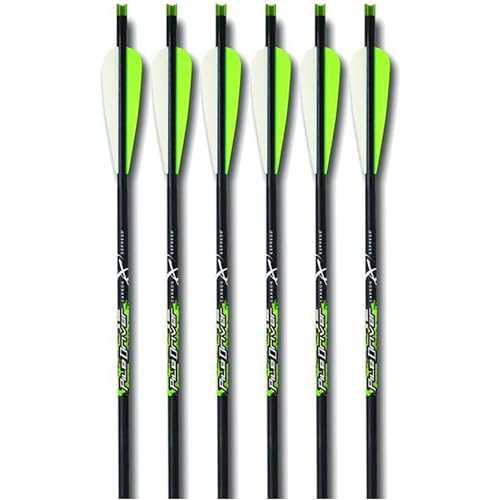
Carbon Express PileDriver
Carbon Express PileDriver Crossbolts Universal Nocks - 20" (6-Pack)
by Carbon Express
Affiliate link: I may earn a commission, at no cost to you.
Key features
- Heavy carbon bolts: about 442 gr at 20″, 479 gr at 22″
- More weight means more momentum, but more drop at long range
- Pick the pack with your crossbow’s nock style, moon or flat
- Straight to ±.004″, with factory-fitted 4″ vanes
Specs
- Brand
- Carbon Express
- Model
- 52140
- Size
- 20-Inch
- Color
- Multi
- Length
- 20.5 inches
- Weight
- 0.5 pounds
Affiliate links: I may earn a commission at no extra cost to you.
For a weight that suits hunting, read the best crossbow bolt weight for hunting, and check the balance with my FOC guide. Then practice with the exact bolts you’ll hunt with.
Here’s TenPoint’s full three-minute tech tip on the two materials.
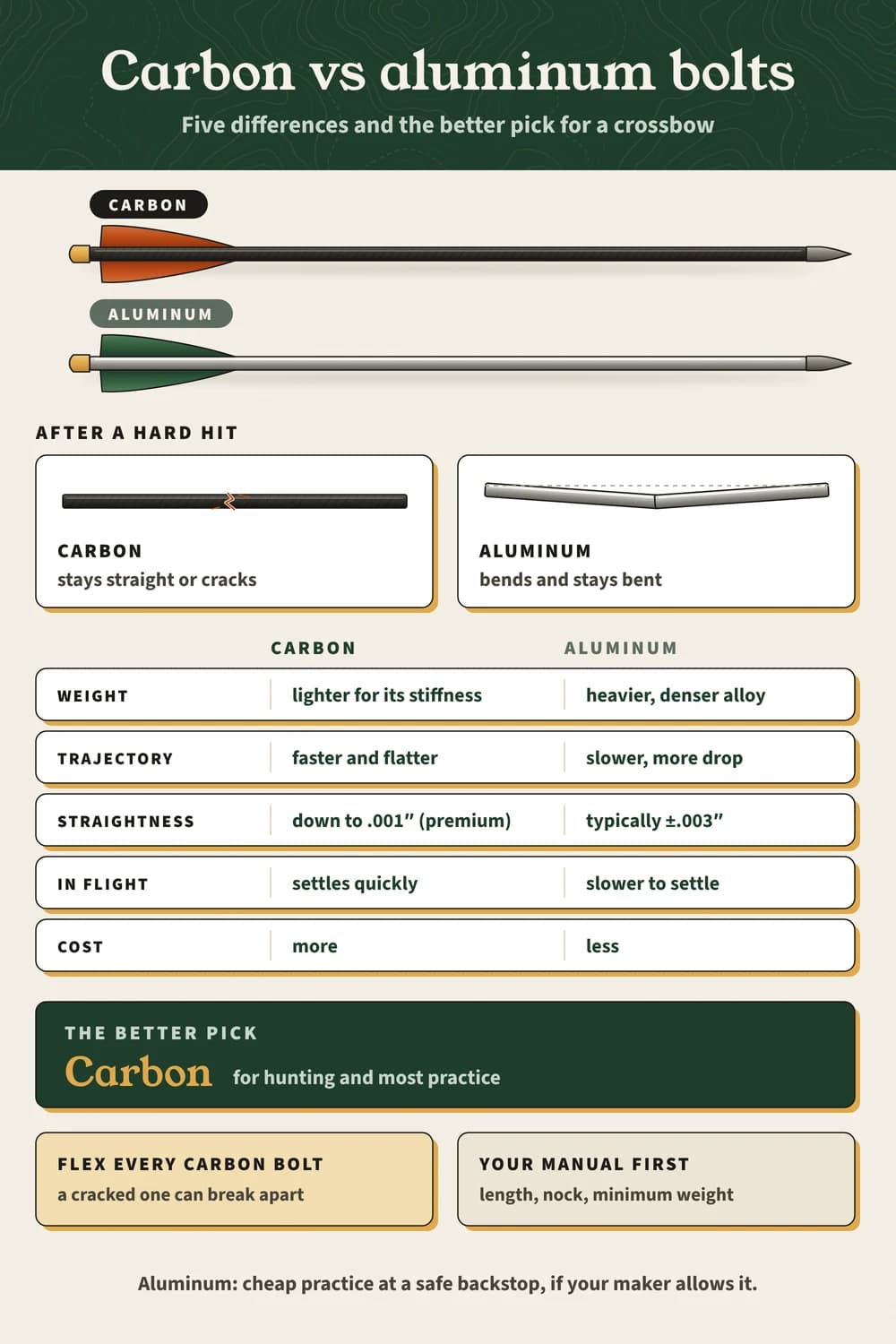
Here's the carbon-or-aluminum decision boiled down to one page you can check at the store.
// FAQ
Frequently asked questions
Quick answers to the questions readers ask most.
Are carbon or aluminum crossbow bolts more accurate?
Both can be accurate when straight, but carbon holds its straightness after repeated shots. Premium carbon is also made to tighter straightness, .001″ against about .003″.
Can you straighten a bent aluminum crossbow bolt?
Not reliably. TenPoint says a bent aluminum bolt is very hard to straighten, so retire it from hunting.
Do aluminum bolts hit harder?
They’re usually heavier, which carries more momentum, but they fly slower with more drop. A heavy carbon bolt gives you the weight without the bending.
How do I know if a carbon bolt is cracked?
Flex it gently along its length and listen and feel for cracking, then twist it; one that relaxes or twists easily is damaged. The full check is in my crossbow bolts guide.
Can I mix carbon and aluminum bolts?
Not in one setup. They weigh and fly differently, so zero your scope with one bolt type and stick to it.

Final thoughts
Carbon is the bolt to buy for a modern hunting crossbow: lighter for its stiffness, flatter and straight shot after shot. Keep aluminum for cheap practice at a safe backstop, and retire any bolt that bends or cracks.
Number your bolts and note which ones wander in my free range log. You’ll find the bad one fast.
