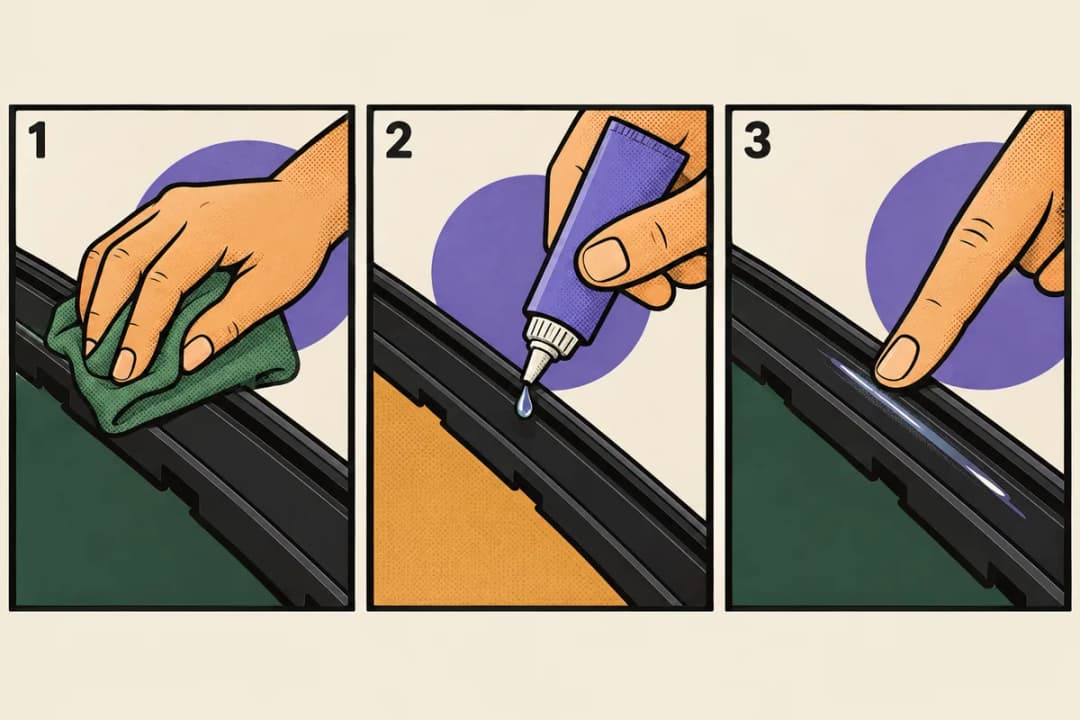


- Do the finger test before every session: if the rail feels dry or has dry spots, lube it.
- A thin, even sheen from end to end is the goal; a glob of lube gums up the serving and the trigger.
- Rail lube goes on the rail, wax goes on the string; never wax, WD-40, grease or petroleum jelly on the rail.
- Your maker’s manual sets the interval and the product, and it beats any shot count you read online.
One minute. That’s what it takes to protect the hardest-worn part of your crossbow. ⏱️
Wipe the rail clean, put a small drop of crossbow rail lube on each side of the rail and spread it into a thin sheen, then check it with your finger before every session. If the rail looks dull and the center serving is turning gray, you’re overdue: that serving slides down the rail every shot (see the crossbow anatomy).
Why a crossbow rail needs lube: friction wears out your serving
On most crossbows the string’s center serving rides on the rail (the flight deck) for the whole power stroke. A dry rail means friction on every shot, and the serving takes the wear.
A serving that has run down a dry rail can look scorched and discolored. TenPoint says rail lube cuts friction, adds arrow speed and extends the life of the center serving, and a well-lubed rail also helps shots stay consistent.
A few designs work differently. TenPoint’s manual leaves out its rail-less models, and Ravin says its system floats the arrow and string above the rail. If your crossbow is one of these, follow its own manual, not this routine.

// Free printable
Get the range log I actually use.
Seventeen printable pages: session log, score tracker, a 30-day drill challenge, a bow maintenance card, a first-season checklist and more. Join the monthly email and it lands right away.
Rail lube vs string wax: two products, two jobs
The confusion is understandable, some kits are sold as “lube wax” and some brands make both. They are different products for different parts, and mixing them up causes problems.
| Product | Goes on | Keep it off | What it does |
|---|---|---|---|
| Rail lube (liquid) | The rail, end to end | The trigger box, the cams | Cuts friction between rail and serving |
| String wax | The string and cables | The rail; the center serving on most makers’ advice | Keeps strands from drying and fraying |
| Lube oil (a drop) | Axles, cams, trigger parts, as the manual says | The rail and the string | Keeps moving parts free |
Death by Bunjie, a long-running crossbow hunting channel, made a whole video on this question. His rule for the rail is short:
You do not put wax on the rail. Wax doesn’t go on your rail… Also, don’t use WD-40 on your shooting rail. That’s just not appropriate for crossbows.
He’s right, and the makers agree. One nuance: TenPoint’s own maintenance video does use a little WD-40 inside the trigger box to push out moisture after a wet hunt. That’s a drying job in a different part of the bow; on the rail, use rail lube and nothing else.
For the string itself, use the wax your manual names. If it doesn’t name one, a wax made for synthetic bowstrings, like Bohning’s Tex-Tite, is the usual pick:

Tex-Tite Wax
Bohning 1306 Tex-Tite Bowstring Wax 1oz, Clear
by Bohning
Affiliate link: I may earn a commission, at no cost to you.
Key features
- String wax made for synthetic bowstrings
- Keeps fibers from drying and fraying, so the string lasts longer
- Stays tacky in heat and cold, so it works year round
- Small 1 oz tube that fits in a quiver pocket
Specs
- Brand
- Bohning
- Model
- 1306
- Size
- 1 Ounce (Pack of 1)
- Color
- Clear
- Length
- 9.8 Inches
- Weight
- 0.05 Pounds
How to apply rail lube to your crossbow in 5 steps
The whole job takes about a minute. Do it before you cock the crossbow, never on a cocked bow.
Step 1: Uncock and unload the crossbow
Step 2: Wipe the rail clean
Run a dry cloth along the rail to lift grit and old lube. Dirt stuck in the lube can stop the bolt sitting level, and it acts like sandpaper on the serving.
Step 3: Put a small drop on each side of the rail
One small drop on each side of the top of the rail is enough. Many bottle’s have a foam or felt applicator; in hot weather they can release too much, so dab some on a fingertip instead.
Step 4: Spread it into a thin sheen, end to end
Run a finger down the full length of the rail until it has an even, light sheen with no dry spots. You should see it, not feel it pooling.
Step 5: Keep it out of the trigger box and wipe the extra
Stop at the end of the rail; lube that runs into the trigger housing collects grit and can gum up the latch. Wipe off anything that’s pooled before you cock the bow.
How often to lube a crossbow rail: the finger test beats a shot count
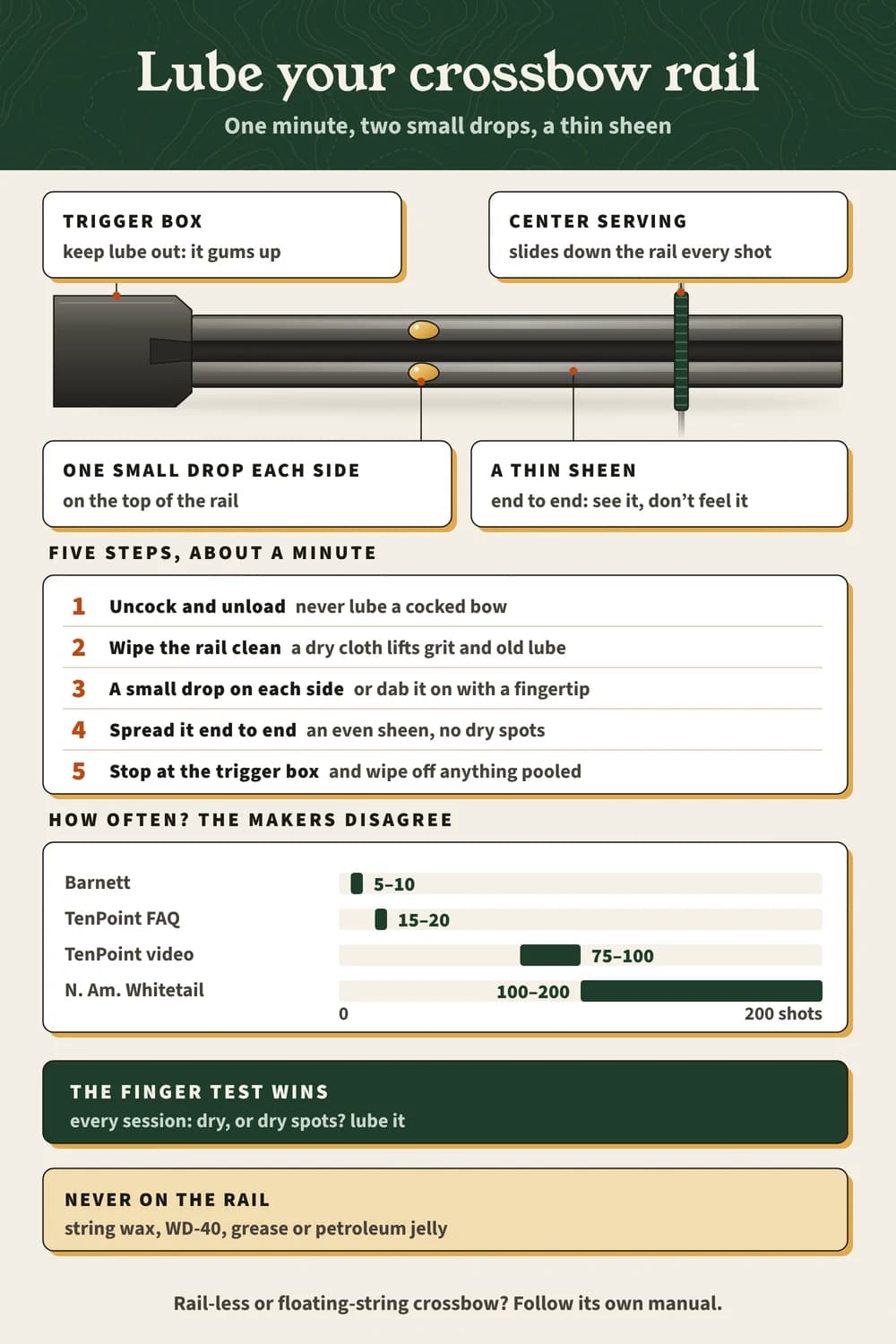
Makers give very different numbers, because bows, speeds and lubes differ. That spread is why the finger test is the rule here, with your manual’s interval as the backup:
| Source | Advice |
|---|---|
| Barnett | Lube the rail every 5–10 shots |
| TenPoint (FAQ) | Run a finger down the rail before shooting; lube if dry; likely every 15–20 shots on a high-performance crossbow |
| TenPoint (maintenance video) | Every 75–100 shots |
| North American Whitetail | Every 100–200 shots |
Death by Bunjie makes the same point from the other side, about shooters who only get out a few times a year:
Do not think of it in terms of a number of shots… I just take a little bit of it, put it on and make sure there’s a nice sheen every time that I shoot it.
I agree with him. A shot count can leave a rail dry for months between range days, because lube dries out over time, not just with shots. Check it by feel each session and after the crossbow has sat in storage, and add a little whenever it feels dry.
What to use as crossbow rail lube
Use the rail lube your crossbow maker sells or names (most include a small bottle in the box). The maker’s lube is matched to its rail and serving, and a bottle lasts a long time.
- Use: a lube sold as crossbow rail lube (TenPoint, Barnett, Bohning, Scorpion Venom and others make one), or what your manual lists.
- Don’t use string wax on the rail: it adds friction instead of cutting it.
- Don’t use WD-40 on the rail.
- Don’t use grease, petroleum jelly or household oils: they hold dirt and grit.
TenPoint’s maintenance video gives the reason for that last one, and a warning about overdoing even the right lube:
Too much oil, however, can break down your string’s center serving. Finally, don’t use grease or petroleum jelly because they will attract dust and grit, eventually gumming up the trigger mechanism.
That’s the balance in one line: enough lube for a sheen, never so much that it soaks the serving. My own bow is a recurve with no rail, so this routine comes from the crossbow makers’ manuals and long-time owners, not my own bench.
Rail lube mistakes that wear out your serving
Each of these is easy to avoid. Most of them come from doing too much, not too little.
- Lubing a dirty rail, which turns grit into a grinding paste. Wipe first.
- Waxing the center serving when your maker says not to: wax builds up in the trigger box and can stop the string latching.
- Forgetting after storage or rain. Check the rail before the first shot of the season and after a wet hunt.
- Ignoring the serving. If it looks scorched, flattened or separated, lube won’t save it: have the string checked.
For a quick check at the bench, the whole routine fits on the one page below.
// FAQ
Frequently asked questions
Quick answers to the questions readers ask most.
How often should you lube a crossbow rail?
Check it with your finger before every session and lube it whenever it feels dry. Your manual’s interval is the backup: Barnett says every 5–10 shots, TenPoint about every 15–20 on high-performance bows.
Can I use WD-40 as crossbow rail lube?
No. Use a lube made for crossbow rails; WD-40 isn’t one, and household oils and grease hold grit.
Does rail lube go on the string?
Rail lube goes on the rail. The string and cables get string wax, kept off the center serving unless your maker says otherwise.
Can I use string wax on a crossbow rail?
No. Wax on the rail adds friction instead of cutting it. Wipe it off and use rail lube.
Do all crossbows need rail lube?
Most do, because the serving rides on the rail. Rail-less and string-floating designs, like Ravin’s, follow their own manual.
What happens if you don’t lube a crossbow rail?
Friction wears the center serving faster and can cost speed and consistency. A worn serving means a new string sooner; see how long a crossbow lasts for the full care routine.

Final thoughts
Rail lube is the cheapest care a crossbow gets: finger test, wipe, two small drops, a thin sheen. Keep wax on the string, keep oil out of the rail, and your serving will last.
Log each lube and string check next to your groups in the free range log, so you can see when the bow starts asking for care.
